ULO4: Explain the mechanism of electrochemical oxidation of different electroactive molecules and justify key thermodynamic and kinetic parameters.
Organic electrosynthesis was one of the topics I had the most interest it. This topic started to link with previously learnt chemistry and made the practical applications much more prevalent.
My knowledge of the use of electroactive molecules was demonstrated through the quiz on concept 8. I did not receive full marks on this quiz, however, felt I had a strong understanding of the topic. This topic was where I felt most comfortable with my knowledge. This was also due to it being of interest to due to it broad area of application.
Mediators:
Biological examples of redox reactions are often irreversible due to a slow reaction rate. Mediators act similar to a catalyst where they help the electron transfer.
Classification of mediators:
- Inner/outer sphere
- Oxidative/reductive
- Organic/inorganic
Through the readings, I did not understand the organic electrosynthesis concepts. After completing the quiz and Angel’s explanation I felt much more comfortable with the information. The reading provided a lot of information on a lot of different types of mediators and was a lot to understand in the one topic. Even after I had gained a strong understanding, I do not believe I would be able to sit a test on this due to the extent of information provided, however, I do feel I understand the concepts due to similar concepts being used in previous units. Given more time I believe this topic would have been extremely interesting to look in to and have a lot of practical applications of interest to me.
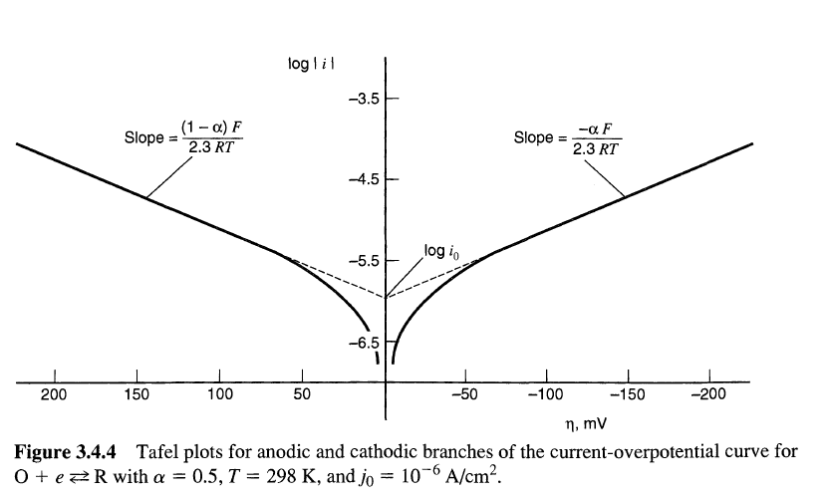
My demonstration of the kinetic parameters was shown in the explanation of Tafel plots. I found this information quite easy to understand but would have liked more opportunities to apply this knowledge. I felt I understood how to use this information when the graphs were perfectly set out, as seen in the image below. though I would have like to had more of an opportunity to test my knowledge on more real-world applications. I personally like to apply my knowledge to multiple questions on the same topic to ensure my understandings.
Tafel Plots
- Log I vs n
- evaluates kinetic parameter
- determine open circuit potential
- shows affects of mass transfer
- Y intersection gives the I0 value (exchange current density)
- Transfer coefficients determined from the slopes: how much the potential needs to be increased to increase the rate of oxidation or reduction
 Learning Portfolio